


Back pain radiating down the leg, numbness, or weakness caused by a herniated spinal disc is a common problem that affects many people's daily lives. While most patients improve with rest, medication, or physical therapy, a smaller group continues to experience chronic pain or nerve compression severe enough to interfere with daily activities.
Today, in addition to open surgery, there are treatment options that involve smaller incisions and less tissue trauma. One such option is percutaneous laser disc decompression (PLDD).
What Is PLDD Treatment?
PLDD is a treatment for herniated discs that uses laser energy to reduce the volume of the bulging or protruding disc material, thereby decreasing pressure on the nerve and relieving pain, numbness, or radiating leg pain.
It is performed through a small needle under local anesthesia, so general anesthesia is not required. There is no large surgical incision, and the procedure disturbs the surrounding tissue far less than open surgery. Most patients can go home on the same day and require only a short recovery period.
Who Is a Good Candidate for PLDD?
PLDD is not the first-line choice for everyone with back pain, but it is suitable for those who have already tried conventional treatments or are seeking a non-major surgical alternative. Generally, ideal candidates typically present with the following characteristics:
- Patients diagnosed with a herniated disc
- Patients with chronic lower back pain or radicular pain caused by a herniated disc
- Patients considering disc surgery who want a non-open-surgery alternative
- Patients who have previously had disc surgery but have not improved, or whose symptoms have recurred
- Patients who are apprehensive about, or wish to avoid, major surgery
- Patients who do not want a long hospital stay
- Patients seeking a minimally invasive treatment with a small incision and short recovery time
Who Is Not a Suitable Candidate for PLDD?
Conversely, there are certain conditions that require special clinical consideration before choosing PLDD, as they may increase risks or lead to sub-optimal treatment outcomes. Groups that should exercise caution or may not be suitable for this procedure include:
- Patients with a sequestered or extruded (fragmented/displaced) disc
- Patients with spinal instability or deformity, such as severe spondylolisthesis or scoliosis
- Patients with significant spinal canal stenosis
- Patients with severe disc height loss (more than 50% reduction)
- Patients with a systemic infection or infection at the spinal site
- Patients with bleeding disorders or coagulation abnormalities
- Patients with a pacemaker or certain implanted electronic devices
- Pregnant women
- Patients with severe or rapidly progressing neurological deficits, such as worsening muscle weakness or Cauda Equina Syndrome
Having these conditions does not automatically mean PLDD is impossible. A specialist will evaluate suitability and assess risks on an individual basis to ensure the treatment is safe and genuinely appropriate for each patient's body. Once evaluated as suitable, the next step is the actual procedure, which is performed on an outpatient basis and is far less complex than many expect.
Percutaneous Laser Disc Decompression Treatment Procedure
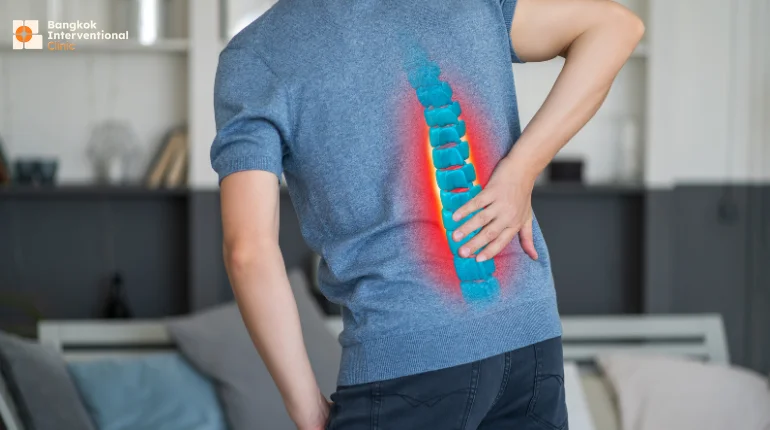
Percutaneous laser disc decompression (PLDD) is an outpatient procedure that takes approximately 60–90 minutes, depending on the treatment site. The procedure follows these steps:
- The patient is given antibiotics to prevent infection, then positioned face-down on the procedure table. The physician injects local anesthetic at the needle insertion site. In some cases, an anesthesiologist may also administer a sedative to improve the patient's comfort during the procedure.
- The physician inserts a small needle through the skin into the center of the affected disc, guided in real time by fluoroscopic (X-ray) imaging to ensure precise and safe needle placement throughout the procedure.
- Once the needle is correctly positioned, the physician threads a thin laser fiber through the needle into the disc. Laser energy is then delivered to vaporize a portion of the water within the disc's core (the nucleus pulposus), reducing the disc's volume and, in turn, the internal pressure. The bulging or protruding portion compressing the nerve root gradually retracts and moves back toward its normal position, relieving nerve compression and progressively easing pain, numbness, or radiating leg pain.
Self-care After the Procedure
After PLDD, patients can go home the same day and are advised to gradually resume activities according to their body's ability and comfort.
Care during the first 24–48 hours
- Rest in bed during the first 24 hours to allow the treated disc time to adjust and stabilize.
- Once the local anesthetic wears off, some soreness at the needle site is common; apply a cold compress within the first 24–48 hours, or take pain medication as directed by your physician.
- Keep the wound site dry and covered with a sterile dressing for at least 24 hours. Avoid soaking in water—baths, swimming pools, or hot tubs—until the wound has fully healed.
Care during the first 2–4 weeks
- Walking can begin within 24 hours after the procedure, starting with short periods of 5–10 minutes several times a day to help reduce stiffness and promote blood circulation. Avoid walking on steep inclines.
- Avoid sitting or standing continuously for more than 60 minutes; change position or walk around periodically.
- Avoid lifting anything heavier than 2–3 kg (about 5 lbs), and avoid excessive bending or twisting of the spine during the first 4 weeks.
- Avoid driving for the first 2 weeks, or until cleared by your physician, and only once you are no longer taking pain medication that could affect your ability to drive.
- Wearing a lumbar support or back brace is recommended for the first 2–4 weeks to help reduce pressure on the disc and support recovery.
Long-term care (from week 4 onward)
- Avoid high-impact sports, running, or strenuous exercise for at least 6 weeks after the procedure.
- Your physician may recommend starting physical therapy and rehabilitation from week 3–4 onward to strengthen the core and back muscles, which play an important role in preventing recurrence of pain.
Outcomes After Treatment
Most patients begin to notice pain improvement starting around 2 weeks after treatment. Studies show that the benefits can last 1–3 years, with some patients experiencing improvement for even longer. This helps reduce pain, improve the ability to carry out daily activities, and reduce the need for further treatment in the future. ผลลัพธ์หลังจากการรักษาสามารถคงอยู่ได้นาน 1-3 ปี This helps reduce pain, improve daily functioning, and decrease the need for additional treatments in the future.
Risks and ComplicationsComplications
Following the PLDD procedure, side effects are generally mild and temporary. Common symptoms include:
- Pain at the needle insertion site
- Temporary back pain
- Numbness or a tingling sensation
- Stiffness or spasms in the thigh or leg muscles
These symptoms typically resolve gradually within a few days to about 1 month. However, if symptoms do not improve, pain worsens, or other side effects occur, it is recommended to consult the treating physician to identify the cause and receive appropriate medical care.
Treating Back Pain at Bangkok Interventional Clinic

If back pain radiating down your leg is something you have tried resolving through various methods without improvement, or if you are hesitating about major surgery, let Bangkok Interventional Clinic (BIC) help evaluate your condition. If you are living with chronic pain, Bangkok Interventional Clinic (BIC) ช่วยประเมินให้
The clinic is led by Assoc. Prof. Dr. Marvin Thepsoparn and a group of medical professionals from Chulalongkorn Hospital. We focus on in-depth treatments specifically tailored to each individual's physical needs.
- All patients are evaluated and treated by a board-certified pain specialist, ensuring accuracy, safety, and effective care.
- Utilizes targeted pain interventions to help reduce symptoms in a timely manner.
- Provides guidance to patients to collaboratively plan sustainable self-care.
For the PLDD program at Bangkok Interventional Clinic, the treatment fee is … THB. You can schedule an appointment for a medical evaluation or contact us for further information at +66 93-392-3992 or LINE OA: @bicpain. Our clinic staff are ready to provide helpful recommendations. 093-392-3992 หรือ Line OA: @bicpain เจ้าหน้าที่คลินิกของเราพร้อมให้คำแนะนำอย่างดีที่สุด
However, the treatment outcomes depend on individual patient responses and should be evaluated by a specialized physician prior to receiving treatment.
Summary
Back pain radiating down the leg, numbness, or weakness from a herniated disc that does not improve with rest, medication, or physical therapy may require a more specific alternative. Percutaneous laser disc decompression (PLDD) is a minimally invasive outpatient procedure that uses laser energy to reduce the volume of the disc compressing the nerve, helping to alleviate symptoms without open surgery. The PLDD procedure takes approximately 60 to 90 minutes. Many patients begin to see improvement from two weeks onward, and side effects are generally mild and temporary. However, percutaneous laser disc decompression is not suitable for all patients, particularly those with a ruptured disc or spinal instability. Therefore, patients should always be evaluated by a specialized physician before deciding to undergo treatment.
คำถามที่พบบ่อยเกี่ยวกับการรักษาหมอนรองกระดูกสันหลังเคลื่อนด้วย PLDD
What is the success rate of PLDD laser surgery?
The outcomes of percutaneous laser disc decompression vary depending on the individual patient's condition. A large number of patients experience significant pain relief and improved mobility following the procedure.
How long does PLDD last?
The benefits of a PLDD procedure can last one to three years, and some patients may experience improvement for an even longer duration, depending on their spinal health and postoperative care.
What are the side effects of PLDD laser surgery?
Side effects of percutaneous laser disc decompression are generally mild and temporary, including soreness at the needle insertion site, temporary back pain, or mild numbness that typically resolves over time.
Is PLDD performed under general anesthesia?
No, percutaneous laser disc decompression is an outpatient procedure performed under local anesthesia, though a mild sedative may be given to improve patient comfort.